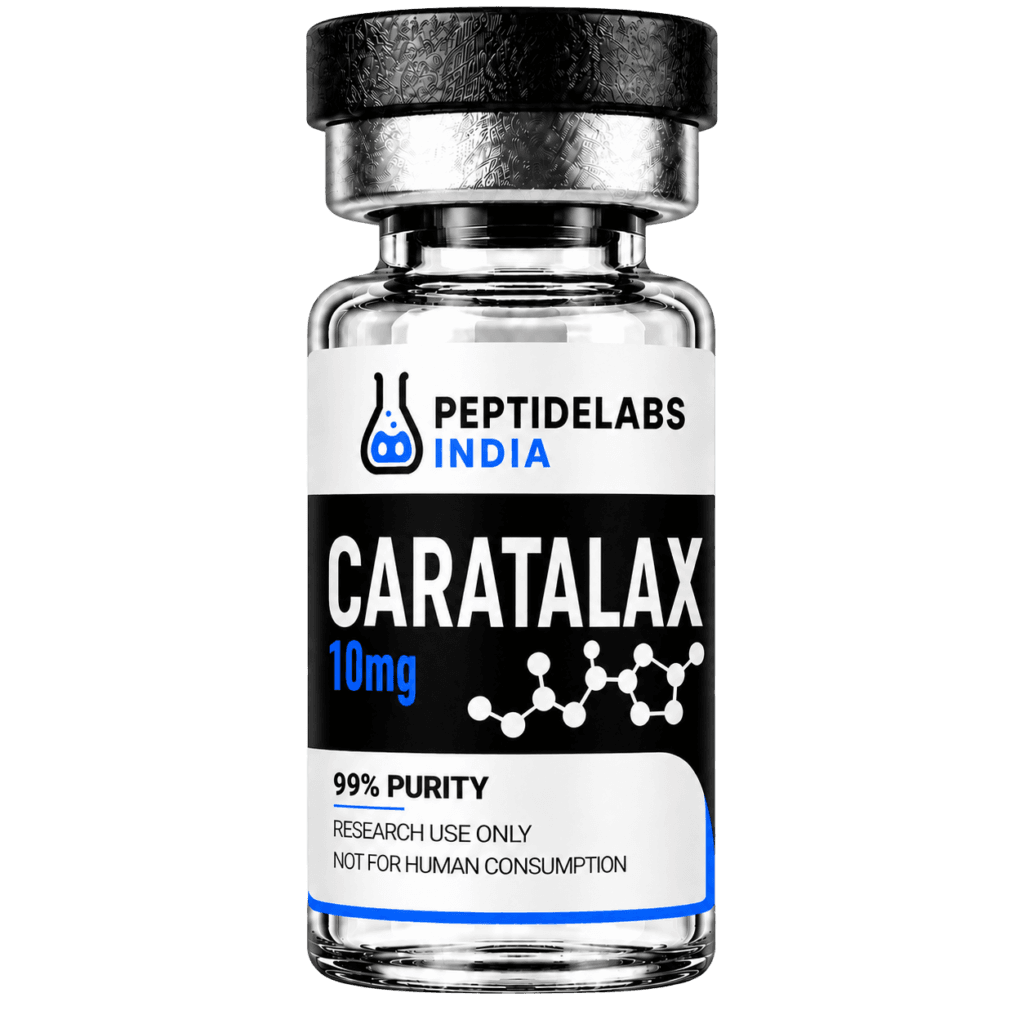
Cartalax 10 mg
View testing results & request a batch-specific COA →
Select an available format to see pack pricing.
Research notes & technical details
Cartalax 10 mg for Research Use
Table of Contents
Cartalax 10 mg is a research-use short peptide bioregulator being prepared for release by PeptideLabs India. Coming Soon. Availability will begin only after the selected batch completes identity, purity, and quality-control review. This page provides laboratories with a clear scientific identity, research context, specifications, handling notes, and documentation expectations.
Cartalax is commonly identified as the tripeptide Ala-Glu-Asp, abbreviated AED, and is also referenced as T-31. Public chemical databases describe the compound as alanyl-glutamyl-aspartic acid. Research literature has examined AED in experimental models involving cartilage-associated cells, extracellular-matrix biology, gene-expression markers, and age-related cellular processes. These studies are preclinical and do not establish a medical indication or clinical outcome.
Cartalax 10 mg Overview
The Cartalax 10 mg format is intended for qualified laboratory programs that require a defined quantity of AED for analytical, stability, method-development, or controlled in-vitro research. As a three-amino-acid peptide, AED has a compact structure that can be studied using standard peptide-characterisation approaches. Product identity must still be connected to batch-specific analytical evidence rather than inferred from the name alone.
Researchers should review the certificate of analysis, verify that the lot details match the vial received, and define acceptance criteria before beginning an experiment. Appropriate records include identity method, purity method, instrument conditions, solvent system, target concentration, storage history, and all deviations from the study protocol.
Scientific Identity of Cartalax
- Common name: Cartalax
- Reference sequence: Ala-Glu-Asp
- Abbreviation: AED
- Alternative name: T-31 peptide
- Reference CAS number: 85806-95-7
- Molecular formula: C12H19N3O8
- Reference molecular weight: 333.29 g/mol
The chemical identity above follows the public PubChem record for alanyl-glutamyl-aspartic acid. Some commercial pages use inconsistent sequences for products called Cartalax, so researchers should confirm the exact identity in the documentation supplied with each batch. A related peptide must not be treated as interchangeable simply because its name or intended research area appears similar.
Research Applications
Cartalax 10 mg may be considered for controlled non-clinical work focused on the analytical and biological behaviour of the AED tripeptide. Published and database-indexed material associates AED with experimental investigation of cartilage-related models and cellular regulation, but the strength and applicability of individual findings depend on the model, methods, controls, and replication.
Potential laboratory study areas include:
- identity and purity confirmation of the AED tripeptide
- solubility, formulation, and stability assessment
- cartilage-cell and chondrocyte model research
- extracellular-matrix marker studies
- gene-expression and protein-expression assays
- cell-viability, proliferation, and apoptosis controls
- comparative studies with separately characterised short peptides
Biological experiments should include suitable vehicle, negative, and positive controls; documented concentration selection; replicate measurements; predetermined endpoints; and an analysis plan. Results from one assay or one model should not be presented as a validated clinical conclusion. Investigators should distinguish measured observations from mechanistic interpretation and clearly report limitations.
Laboratories planning connective-tissue research can also review related PeptideLabs materials such as GHK-Cu, BPC-157, and TB-500. These links support research-catalog navigation only; they do not imply equivalence, combination guidance, or therapeutic use.
Product Specifications
- Product name: Cartalax 10 mg
- Reference identity: Ala-Glu-Asp (AED)
- Fill quantity: 10 mg
- Target purity: 99% or higher, subject to final batch review
- Form: Lyophilised powder
- Recommended storage: -20°C before preparation
- Availability: Coming Soon
- Category: Peptide bioregulator
- Use classification: In-vitro laboratory research only
Final release information may include batch-specific identity and purity documentation. Researchers should retain the applicable certificate of analysis with the study file and confirm product name, lot number, appearance, identity result, and purity result during receiving inspection. Visit the PeptideLabs testing results section for available documentation and the research library for general laboratory guidance.
Storage and Handling Information
Store unopened Cartalax 10 mg at -20°C in a dry, dark, temperature-controlled environment unless the final batch documentation specifies another condition. Minimise unnecessary heat, moisture exposure, and repeated temperature cycling. Cold vials should be handled according to the laboratory’s procedure for reducing condensation risk before opening.
Use appropriate personal protective equipment, clean preparation surfaces, accurately labelled containers, and controlled waste disposal. Maintain a chain-of-custody record covering receipt date, lot number, storage location, any temperature excursions, preparation date, operator, intended assay, and final disposition.
Preparation and Reconstitution Notes
Cartalax 10 mg may require preparation for certain analytical or in-vitro workflows. Solvent selection, target concentration, container material, filtration, mixing, and storage after preparation must be determined by the qualified investigator according to the assay design and batch documentation. Solubility and stability should be verified experimentally rather than assumed.
If bacteriostatic water is required by an approved laboratory protocol, PeptideLabs lists Bac Water 10 ml and Bac Water 3 ml as separate laboratory supplies. This is not dosage or administration guidance. PeptideLabs does not provide treatment, cycle, or self-administration instructions.
Independent Research Resources
Researchers can consult the public chemical record in PubChem and run an independent PubMed search for Cartalax or Ala-Glu-Asp. Literature should be evaluated by study type, model, sample size, analytical method, controls, and reproducibility. Findings from cell or animal models must not be represented as proven outcomes in humans.
Quality Assurance
PeptideLabs intends to release Cartalax 10 mg only after the selected batch completes quality-control review. Receiving laboratories should independently inspect the vial, verify label and lot details, compare the supplied documentation with the product received, and record any discrepancy before use.
Strong data integrity requires predefined acceptance criteria, suitable controls, repeat measurements, calibrated equipment, retained raw data, and transparent reporting of negative or inconclusive outcomes. Batch documents, instrument outputs, preparation records, and deviation logs should be stored together so the experimental history can be reconstructed.
Cartalax 10 mg FAQ
What is Cartalax 10 mg?
Cartalax 10 mg is a 10 mg research-use product based on the short peptide Ala-Glu-Asp, also called AED or T-31. It is being prepared for release by PeptideLabs India.
Is Cartalax currently available?
No. Cartalax 10 mg is marked Coming Soon. Pricing and ordering will be enabled only after final quality-control review.
Why is Cartalax classed as a bioregulator?
Cartalax belongs to a research tradition involving short peptide bioregulators. The classification describes its scientific context and does not establish a medical indication or approved therapeutic use.
What is the Cartalax peptide sequence?
The documented reference sequence is Ala-Glu-Asp, abbreviated AED. Researchers should confirm batch identity through the applicable certificate of analysis.
Does PeptideLabs provide dosage instructions?
No. Cartalax is supplied only for in-vitro laboratory research, so dosage, cycle, treatment, and self-administration instructions are not provided.
How should Cartalax 10 mg be stored?
The current catalog recommendation is -20°C before preparation, protected from light and moisture. Final batch documentation and institutional procedures take priority.
What documentation should a laboratory retain?
Recommended records include the product identity, lot number, certificate of analysis, receipt date, storage conditions, preparation method, solvent, concentration, operator, assay use, raw results, deviations, and disposal notes.
Research Use Only
Cartalax 10 mg is supplied strictly for in-vitro laboratory research. It is not intended for human or veterinary use, diagnosis, treatment, prevention, supplementation, cosmetic use, or self-administration. Handle only in accordance with applicable laws, institutional safety procedures, and qualified laboratory protocols.
Cartalax 10 mg: product and ordering information
Review the specifications and technical notes for Cartalax 10 mg before ordering for qualified laboratory research. Check the listed price and availability above; where options are offered, select the required format before ordering.
Availability: Currently unavailable for purchase. Contact us for availability before planning an order.
Product reference: CARTALAX-10MG
Category: Bioregulator
Orders are supplied throughout India. See the shipping policy for dispatch and delivery information and refund and returns policy.
Documentation and laboratory handling
- Request the relevant product and batch documentation before ordering.
- Read our guide to peptide certificates of analysis and HPLC purity testing when reviewing peptide reports.
- Follow the product-specific storage instructions and laboratory storage and handling guide where applicable.
For in-vitro laboratory research only; not for human or veterinary administration. Read the research-use policy.
Browse the full research product catalogue · Explore research documentation
Reviews
There are no reviews yet.